
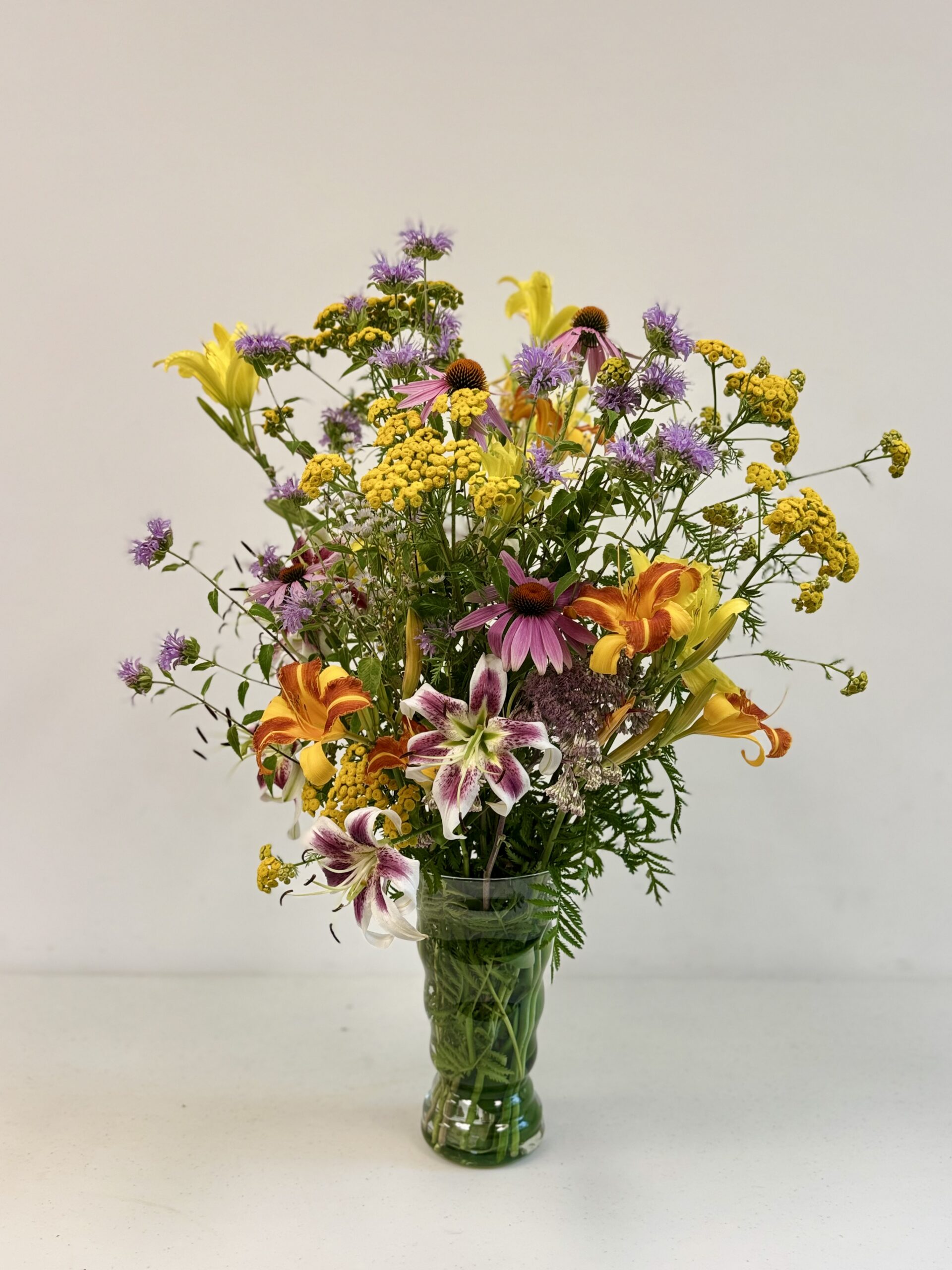
The flowers in this photo didn’t come from a florist. Our Director of Programming & Communications, Jeremy Bork, cut them himself from our own prairie and wildflower trails as well as his own home garden—three kinds of lilies, bee balm, coneflowers, and more. Nothing arranged to match a color palette. Just what the land was already offering, gathered and carried in. If you look closely, you’ll notice the stems don’t all lean the same direction. That’s not a flaw. That’s the prairie, telling the truth about itself, a diversity of flowers, grasses, and trees freely and wildly growing together.
I keep coming back to that arrangement, days later, because it’s impacted me in ways I didn’t expect. It reminds me of a repeated experience in nature.
When I was a child, three magnolia trees stood in my backyard. I climbed them with wonder and abandonment to the present moment — the kind of wonder and spontaneity that gets harder to hold onto as the years teach us to be careful, measured, deliberative. But those trees didn’t teach me caution. They held me up. They kept me grounded and secure—thick branches, steady and strong, the kind of strength that is simply, reliably there.
As I grew older, the trees turned into something I carried with me rather than something I stood beneath—a memory I’d reach for in the challenges and upheavals of adult life. They still are. When I need to settle myself, I close my eyes and return. I sit beneath their sprawling limbs. I breathe in the scent of their waxen flowers. I remember the smooth, thick petals against my fingers. And in that space, I slow down. I remember what it means to simply be, without needing to produce anything or prove the time was well spent.
There’s real research behind that experience, not just sentiment. Environmental psychologists describe it through “attention restoration theory,” the idea that natural environments replenish the mental energy that sustained focus and modern life drain out of us. That’s partly why a walk in the woods can leave us clearer-headed than any stroll through our inbox. The biophilia hypothesis is similar, suggesting that human beings carry an innate pull toward the living world, toward growing plants and animals, water, open sky, because for most of our history, our survival depended on paying attention to them. We don’t outgrow that pull. We just get better at ignoring it, until a photograph of prairie lilies stops us mid-scroll and asks us to notice again.
World religions and indigenous spiritualities carry this ancient wisdom. The Buddha’s awakening occurred while meditating beneath a tree. Many Indigenous traditions describe the land not as resource but as relative to be listened to, not just tended. According to the New Testament, Jesus said this: “Consider the lilies of the field, how they grow; they neither toil nor spin, yet I tell you, even Solomon in all his glory was not clothed like one of these.” It’s easy to hear that as a nice sentiment about not worrying too much. I think it’s more than that. It’s a confrontation with all that unmoors us. Jesus is looking at people anxious about whether there will be enough, and instead of a strategy, he hands them a lily — something that never toiled, never spun, never earned its value through effort, and was somehow more glorious than a king’s best robes. The lily’s worth was never in question. It only had to exist, fully, as what it was.
Poets know this, too. I encourage you to read Mary Oliver’s poem, “The Singular and Cheerful Life.” Instead of focusing on the most elegant flowers, she finds the holy in ragweed and bull thistle, in morning glories tangled through fields of corn — all plants nobody plants on purpose. She calls them the meanest flowers, and then says they’re obedient to the holiest of laws: “be alive until you are not.” That’s the whole law. Not achievement. Not productivity. Just aliveness, offered fully, for as long as it’s given.
I don’t think it’s an accident that Buddha, Jesus, and the poet all reached for a similar image. There’s something about a flower (and a tree), something that cannot strategize or optimize itself into more glory than it already has, that tells the truth about us more clearly than we can tell it about ourselves. We are, most days, trying so hard. Yet the lily just grows.
So look again at the photo. Let it call to mind your own version of my childhood memory, the place that grounds you when everything else is loud. And let it give you permission to stop toiling. To stop proving. You were invited into this world the way the lily was: before you did anything at all.
________________________________________
This reflection grew out of our summer midweek services which include nature talks, conversations led by our staff each Wednesday evening, in between dinner and worship, on what’s living and moving across our 151 acres. This season we are covering environmental sustainability, herbs for wellbeing, monarchs and migration, the owls of Minnesota, hummingbirds, and honeybees. Each nature talk is its own small invitation to pay attention. If Jeremy’s wildflowers stopped you today, I hope you’ll keep coming back. There’s a lot more of the land still to introduce you to.
Discover more from Mount Olivet Conference & Retreat Center
Subscribe to get the latest posts sent to your email.