
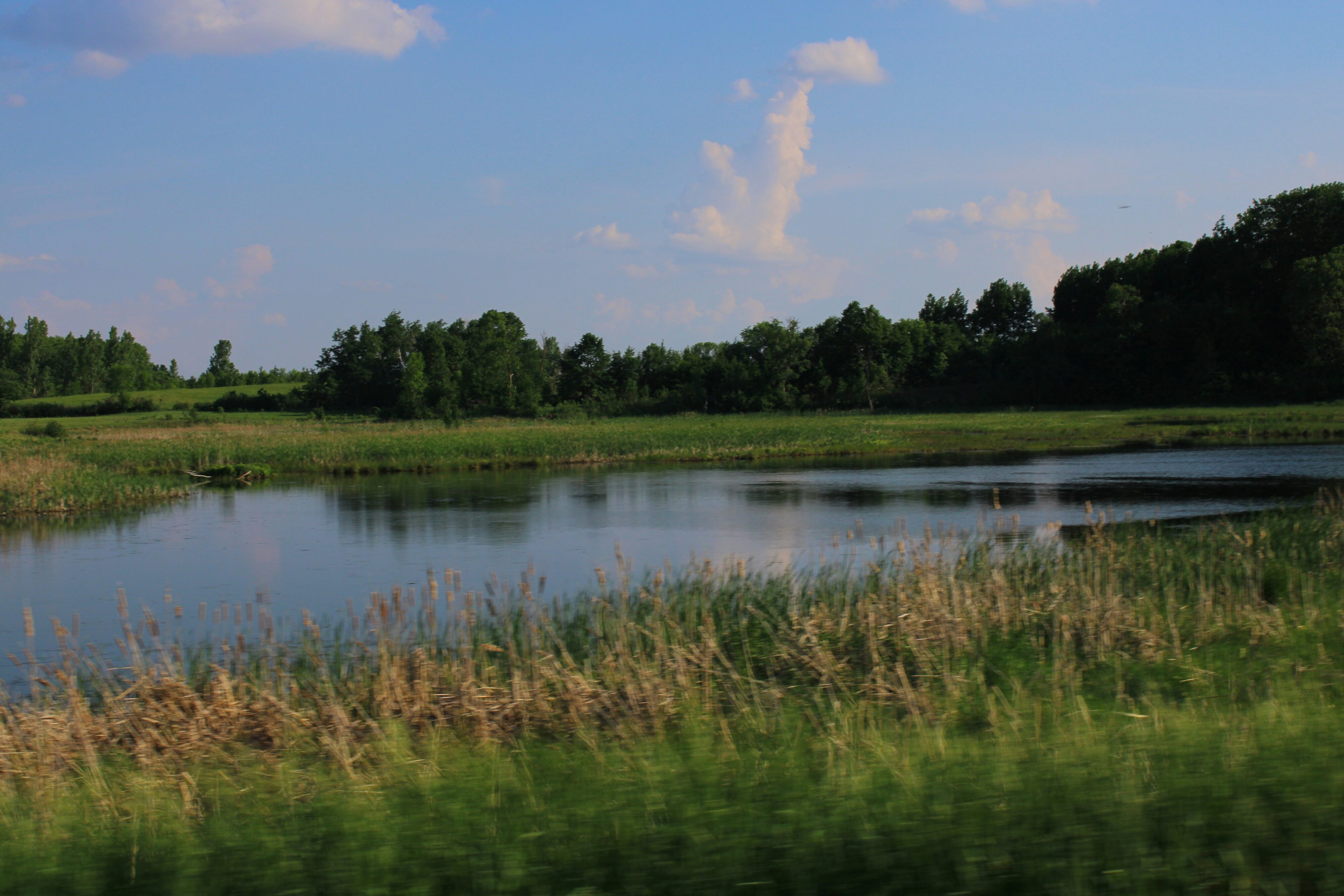
I spent my childhood watching the corn sway from my backyard in Iowa, my teenage years watching the corn fields pass on the way to the nearest Target (the only Target within 30 miles), and my adult years finding myself surrounded by even more corn as a transplant to Minnesota! More than mere corn, however, here I’ve seen the vast wonders – big and small – that Minnesota has to offer. Working at Mount Olivet Conference & Retreat Center has taught me to slow down enough to see these wonders and to appreciate them. I’d love to share with you some tidbits about Minnesota, in hopes that you might feel a little more connected to the land and creatures just outside your own window, wherever that may be.
When I teach, I like to describe a biome as a “natural neighborhood” — a community of plants and animals that have adapted to live together. Here at our Retreat Center, we’re lucky to have three of these mini-biomes right outside our windows: wetland, forest, and prairie.
Long before cities and farmland, Minnesota was a patchwork of three main ecosystems: needleleaf forests, hardwood forests, and tallgrass prairies. Though much has changed, about one-third of the state is still forested- a testament to the resilience of nature. Today, the Minnesota DNR recognizes four main biomes: coniferous forests, deciduous forests, tallgrass aspen parklands, and prairie grasslands.
Our deciduous forests are filled with trees that drop their leaves every fall- a smart adaptation to conserve water and energy through our harsh and seemingly never-ending winters. Oak trees, for instance, grow along prairie edges with wood dense enough to resist fire, while sugar maples thrive near wetlands where moisture keeps them safe.
Further north, coniferous forests dominate- cool, green, and evergreen. These trees thrive in the chill, shaped by glacial history and Arctic air masses.
In between lies the tallgrass aspen parkland, a unique blend of forest and prairie. It’s a rugged, windswept landscape where elk, bears, and sandhill cranes roam among patches of trees and open grass. Though tough and unpredictable, it’s one of Minnesota’s most striking regions.
And finally, prairie grasslands- once stretching across 18 million acres of the state, now only about 180,000 remain. Prairies are tough; they survive drought, fire, and grazing. Their roots can reach three times deeper than the plants are tall, holding soil in place and storing massive amounts of carbon underground. Every few years, we even do prescribed burns at the retreat center to keep our prairies healthy and thriving.
No Minnesotan Lake is complete without the Common Loon. Their haunting call is the soundtrack of northern summers. Loons are expert divers, able to plunge 180 feet underwater and hold their breath for over 15 minutes. They’re clumsy on land but powerful in the air, flying up to 70 miles per hour during migration. Check out this video of a loon taking off, I always end up cheering for them when they finally fly!
Then there’s the monarch butterfly, our state insect and one of nature’s great travelers. Each summer, four generations of monarchs are born here, but it’s the last one that makes the long journey to Mexico. Their caterpillars feed exclusively on milkweed- a plant as essential to their survival as wings are to flight.
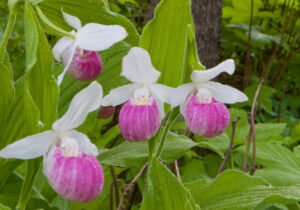
And, our state flower, the showy lady’s slipper. These rare orchids can live for half a century but take up to 16 years just to bloom. Protected by law since 1925, they’re a symbol of both beauty and patience.
Finally, with over 11,000 lakes, Minnesota had to have a state fish- the walleye. They’re light-sensitive, preferring deep waters by day and moving to the shallows to hunt at night. Their glassy eyes give them their name- and their mystique.
These landscapes and creatures aren’t just pretty to look at- they sustain life, clean our air and water, and fuel our economy. But beyond that, they remind us of something deeper: that everything here is connected.
From the tiniest butterfly to the call of the loon echoing across a still lake, Minnesota’s biomes tell a story of balance, resilience, and beauty. It’s our story- one worth exploring, protecting, and passing on.
A Blessing for You-
May you find beauty
in both the stillness and the change-
in the hush of winter
and the promise it holds for spring.
May you pause to notice
the small moments,
the quiet shifts,
and remember-
even in the cold,
life is preparing to bloom again.
Discover more from Mount Olivet Conference & Retreat Center
Subscribe to get the latest posts sent to your email.